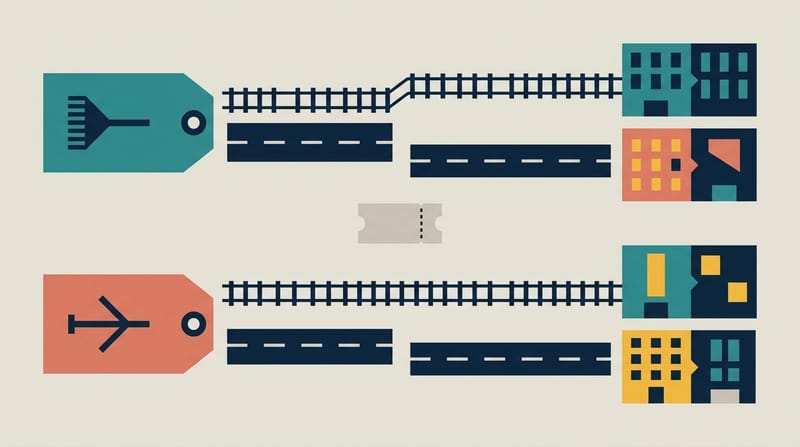
After landing in Bangkok, the first question should not be “what is the cheapest vehicle?” First confirm whether the flight arrives at BKK or DMK, then check which station or neighborhood connection serves the hotel area. Group size, luggage, arrival time, transfer load, final walking and traffic uncertainty should be assessed together.
BKK or DMK first? Confirm the airport code
Bangkok is served by two main airports, and they are not parts of the same terminal. BKK is Suvarnabhumi, while DMK is Don Mueang. Rail systems and boarding points at one airport should not be assumed to exist at the other; route planning should start with the code on the ticket.
BKK: Suvarnabhumi Airport
AOT confirms that the Airport Rail Link station at Suvarnabhumi is on Level B1 of the main terminal. ARL can provide a rail first leg toward the city, but continuing by BTS or MRT is a separate transfer step and should not be treated as one fare network. Check current operating hours and access details on the official ARL and AOT pages before travel.
DMK: Don Mueang Airport
Official Don Mueang passenger information lists the Red Line commuter rail, A1–A4 airport buses, taxis and the BKK–DMK service for connecting-flight passengers. Don Mueang station on the Red Line does not run directly to every hotel area; most journeys should be judged by the next rail, bus, taxi or walking step.
Six questions to answer before leaving the airport
Even two trips from the same airport can have different best choices. It is more useful to judge the full chain from terminal door to hotel area than to choose by vehicle name alone.
- 1. Does the flight land at BKK or DMK?
- 2. Which station, neighborhood or main-road connection is closest to the hotel area?
- 3. How many people are traveling and how much luggage is there per person?
- 4. Does the arrival time fit the operating window of the selected rail or bus service?
- 5. How many transfers are needed, and how much walking with luggage is involved at each one?
- 6. Is reducing traffic uncertainty more important, or reducing transfers and the final walk?
How to choose by hotel area
The straight-line distance between airport and hotel is not enough. Consider the hotel’s real walking access to ARL, Red Line, BTS or MRT, whether transfers require level changes or going outside, the group’s luggage and late-night arrival. The board below is not a price ranking; it is a first filter.
Bangkok Arrival Board
Narrow the first options by airport and hotel connection.
Areas with a sensible onward connection from the Phaya Thai direction or around Makkasan
Solo/couple, manageable luggage
BTS/MRT onward travel is a separate transfer; check current hours and access.
Areas far from rail or with a difficult final walk
Groups, families with children or heavy luggage
Traffic, fares, tolls and pickup points can vary.
Areas sensibly reached onward via Krung Thep Aphiwat/Bang Sue
Light luggage, comfortable with rail transfers
Not direct to every hotel area; check current operations and connections.
Areas that fit A1–A4 corridors or make sense by direct taxi
Bus-route fit or groups wanting fewer transfers
Verify route, hours, boarding point and traffic conditions on official pages.
Not for hotels; airport to airport
Connecting passengers who meet eligibility rules
Check ticket/onward-flight proof, ID and current service conditions with AOT.
Fares, hours, frequency, boarding points and eligibility can change; check the official operator page before travel.
Choosing rail does not mean the journey ends at the last train station. ARL, BTS, MRT and the Red Line are different lines and operating systems; plan each interchange as a separate step and include the real walk from the final station to the hotel.
Getting from BKK Suvarnabhumi to the city
Airport Rail Link: start by rail, then transfer separately if needed
At BKK, the Airport Rail Link station is on Level B1 of the main terminal. Rail can reduce exposure to traffic uncertainty when the hotel area is near an ARL station or a practical BTS/MRT interchange. ARL, BTS and MRT are not one fare network; a separate ticket, transfer and final walk may be required. Check official operating information before travel.
Taxi and ride-hailing: easier door-to-door travel
Road transport can reduce transfer burden for travelers with heavy luggage, groups, or hotels far from rail. Bangkok traffic can make journey times unpredictable. Taxi procedures, surcharges and ride-hailing pickup points at BKK can change, so verify current AOT information.
Getting from DMK Don Mueang to the city
SRT Red Line: useful rail access, not a direct train to every hotel area
DMK is connected to the SRT Red Line. It works well when the hotel area can be reached through a sensible onward connection, but the train does not run directly to every visitor district. The final leg may require another rail line, bus, taxi or walk. Check official SRT Red Line passenger information for current services.
A1–A4 airport buses and road options
AOT lists A1–A4 airport buses, taxis, ride-hailing and other road transport at DMK. The better choice depends on the hotel area's connections, luggage and arrival time. Routes, stops, fares and operating hours can change, so confirm them on Don Mueang Airport's official pages.
If you need to transfer between BKK and DMK
BKK and DMK are separate airports, so an airport change requires a cross-city transfer. AOT publishes a free shuttle for eligible passengers connecting between flights; it is not a general city bus. Proof of onward travel plus identification such as a passport or national ID may be required. Recheck eligibility, documents, hours, frequency and boarding point on the official AOT page on the day of travel, and leave a generous buffer for traffic and terminal formalities.
Common mistakes and a quick answer
A common mistake is comparing only the vehicle fare. Confusing BKK with DMK, treating ARL and BTS/MRT as one system, assuming the DMK Red Line reaches the hotel door, or ignoring the last transfer after a late arrival can make a simple plan difficult. Check the airport code first, then consider the hotel area's station links, passenger count, luggage, arrival time and final walking distance together.