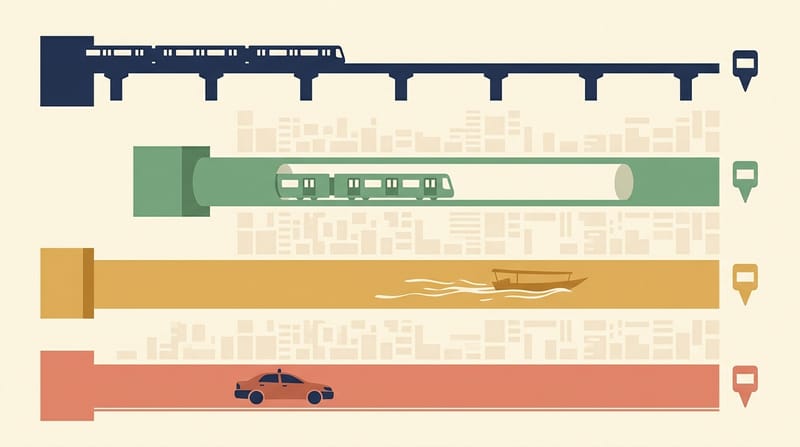
Good transport choices in Bangkok come less from memorising every line and more from picking the option with the lightest transfer and walking burden for a specific trip. BTS, MRT, river boats and taxis each have different strengths, and the best choice changes with the destination, last walk, traffic, weather and luggage.
Keep the networks separate
BTS and MRT should not be treated as one system; they are rail networks with their own operating and ticket rules. “Boat” is not a single river service either: piers, routes and operators can differ. Taxis are road-based, door-to-door transport. A card, ticket or transfer rule that works on one service should therefore not be assumed to work on another.
Choose the destination first, then the mode
Build the decision around final access to the destination, not around the starting point alone. Is the nearest BTS or MRT station genuinely walkable, is there a suitable river pier, or does the last section still depend on the road? A transfer that looks short on a map can add real travel difficulty in heat, rain, crowds, stairs or a long final walk.
- If both ends are close to rail, check the BTS or MRT option with the fewest transfers first.
- For a riverside trip, do not stop at “there is a boat”; check the pier, direction, service type and return option.
- When two options look similar, compare transfer walking and the final walk as well as the number of transfers.
- With rain, heavy luggage, late travel or an awkward last mile, a taxi may be more practical, but traffic and waiting uncertainty still matter.
- Check tickets, cards and payment methods separately for each operator; do not assume a shared fare or pass.
Trip Recipes: which mode fits which journey?
These rows are decision patterns, not station-by-station directions. They help identify which mode naturally fits the shape of a journey and what limit should be checked before choosing it.
Trip Recipes
A quick framework for five common journey types
A city trip that naturally fits BTS
Both ends are close to BTS access
It can provide a direct rail option without relying on road traffic.
Check the final walk to the station and any required line change.
A city trip that naturally fits MRT
Both ends are close to MRT access
It can reduce a long road segment with a direct rail option.
Check station access, exit choice and any required line change.
A riverside-focused journey
Suitable pier access exists at both ends
Using the river can make sense for linking riverside areas without a long road leg.
Confirm the exact pier, direction, service type and return option.
A mixed journey across networks
Best access combines BTS, MRT and a short walk
Using more than one rail network can reduce a long road segment.
Check separate ticket/payment rules and the transfer walk.
A door-to-door backup
Rain, luggage, late travel or an awkward last mile
A taxi can cut extra walking and transfers by providing door-to-door access.
Allow for traffic, vehicle availability and waiting uncertainty.
These are decision examples, not fixed routes; check the official operator map and service information on the day of travel.
These recipes are starting points. On the travel day, check the current BTS, MRT or boat operator map and service information; for taxis, reassess road conditions and the final access to the destination.
BTS and MRT: different networks in the same city
When does BTS make the most sense?
If the destination is close to a BTS station and the trip can stay within the BTS network, BTS is often the simplest choice. The decision should not rely on the straight line on a map alone: access to the station, the correct entrance and exit, and the final walk all matter. If another network is needed, treat it as a separate transfer and check its ticket or payment rules.
When does MRT make the most sense?
When the destination lies on BEM's MRT Blue or Purple Line, MRT can be the better fit, especially if the trip can remain within that network. BTS and MRT should not be treated as one continuous system; interchange points connect journeys, but ticket, card and payment rules are not automatically shared. Check the correct line, entrance and final walk before setting out.
River boats: route fit comes before the view
Before boarding, check the pier, direction, service type and return option
Boats on the Chao Phraya are not one single service. Routes, flag systems and operators can differ even on the same river. It is therefore important to confirm not only the nearest pier, but also which service calls there, in which direction, and whether a suitable return is available. For Chao Phraya Express Boat, use the operator's current official pier and service information; do not apply its rules automatically to other boat services.
Taxi: useful when door-to-door access matters
When can a taxi be the better choice?
A taxi can be a practical backup with heavy luggage, rain, limited mobility, a long final walk or too many transfers. It should not be assumed to beat rail in heavy traffic. It can also be considered late in the day when public-transport options become more limited, but current traffic, pickup location and a practical drop-off point should all be considered.
Choose tickets, cards and transfers trip by trip
Do not assume that one card automatically works across every BTS, MRT and boat service in Bangkok. The safest approach is to check the current ticket and payment rules of each operator that will be used that day. On a journey involving a transfer, allow for the possibility that the next network has its own fare or entry process.
Common mistakes
A common mistake is to assume that two places that look close on a map are also easy to connect. Another is planning BTS and MRT as one network, or assuming every river boat serves the same piers. Ignoring road traffic for taxis, or the transfer and final-walk burden for public transport, can also make a simple day harder than expected. Reassess the mode for each trip according to destination, weather, luggage and number of transfers.