When you buy a Paris Museum Pass, the picture in your head may be simple: show the pass, walk past the queue and go inside. In reality, museum entry is not one single line. A visit can involve separate steps for tickets, reservations, security and the final admission check. To judge the pass properly, focus less on the phrase “skip the line” and more on which step actually disappears.
What does “skip the line” actually remove?
The pass mainly removes the need to buy a separate admission ticket at a covered site. That can mean no waiting to pay or collect a ticket at the ticket office, but it does not make the next checks disappear. As of 2026, some major museums and monuments still require pass holders to book a separate date or time slot. Security is independent of the pass: everyone must go through bag checks, detectors or other screening used by the venue, and no pass exempts you from it.
In practice, even with your pass and any required reservation ready, you may still wait for security and then have the pass scanned at the admission checkpoint. At a venue that requires reservations, showing only the pass does not replace a sold-out time slot; capacity limits still apply. This matters especially at high-demand sites such as the Louvre, because the pass cannot create an available slot when none is left. Rules can change, so verify coverage and reservation requirements on the official site before you go.
ENTRY GATES
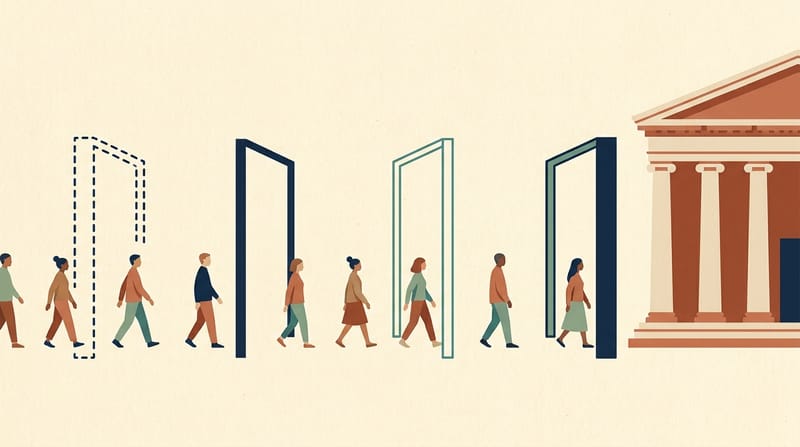
There is no single “museum queue”: a visit can involve several consecutive entry gates. The pass removes only the ticket-purchase step.
Ticket purchase
The ticket-office line and payment step disappear; for covered admission, you do not need to buy another ticket.
Pass removes itReservation slot
Major museums may require a separate time slot; holding the pass does not remove this reservation step.
Still requiredSecurity check
Everyone goes through bag and detector checks; no museum pass gives an exemption from security screening.
Still requiredAdmission check
The pass is checked or scanned at the door; the step may be brief, but this final entry gate still remains.
Still required
1gate removed3gates still required
Coverage and reservation requirements are current as of 2026; verify them on the venue’s official site before you go.
Removing only one of four gates does not make the pass useless. Its practical benefit is that, at covered sites, you do not have to repeat the ticket-purchase process and its ticket-office wait for every visit. You still need to allow time for finding reservations, passing security and completing the admission check. In other words, the pass does not promise “entry with no waiting”; it solves one part of the entry process in advance.
Think of pass coverage as an admission rule, not as a list of places
As of 2026, the Paris Museum Pass provides standard admission to a broad group of museums and monuments in Paris and the surrounding area. But “included” does not mean every section and every event is automatically covered: the pass mainly applies to permanent collections or standard monument admission, while temporary exhibitions, special events or areas with separate access conditions may follow different rules. Some sites also grant free admission according to age, residence or status categories; if you qualify, the extra value of the pass may be lower. Base your decision not on the number of names on the list, but on the admission and reservation rules of the places you will actually visit.
| Place | Included in the pass? | Is a reservation also required? | Note |
|---|---|---|---|
| Louvre | Yes | Yes | As of 2026, pass holders should also reserve a time slot. |
| Musée d'Orsay | Yes | Yes | Pass holders need a free timed reservation. |
| Sainte-Chapelle | Yes | Yes | Security checks can still create a wait despite the reservation. |
| Palace of Versailles | Yes | Yes, for the Palace | No separate time slot is required for Trianon. |
| Eiffel Tower | No | Not applicable to the pass | The Museum Pass is not accepted; a separate admission ticket is required. |
Reservations: the pass solves the ticket, not the capacity
The real bottleneck on high-demand days is the time slot. Holding the pass gives you admission entitlement, but it does not add a new place to a fully booked reservation capacity. At busy sites such as the Louvre and Versailles, suitable slots for your chosen day can run out; buying the pass early enough and arranging reservations immediately helps preserve its practical value. If you build your pass plan around a site for which you cannot secure a reservation, the visit may fail even though the ticket-purchase step is solved.
What remains outside the pass
The Eiffel Tower is the clearest example: as of 2026, the Paris Museum Pass is not accepted there and a separate ticket is required. The official pass conditions also exclude temporary exhibitions from the general coverage, and some special events or restricted areas may apply their own ticket or reservation rules. Even if a museum appears on the pass list, do not assume that the specific exhibition you want to see is automatically included. Before you go, verify the coverage and reservation requirement on the official website.
Who is it sensible for, and who is it not?
Whether the pass makes sense depends more on how you will visit Paris than on how many museums the city has. If you will genuinely visit several included sites within the consecutive validity period and can secure the required reservations, reducing separate ticket purchases can be useful. But its value can fall quickly if your schedule is inflexible, your priority attractions are outside the pass, or you qualify for a free-admission category. Because free entry based on age, residence, nationality or special status varies by site, check your own situation on each official website.
- Makes sense: You already plan to visit several included museums and monuments on consecutive days.
- Makes sense: You can secure the required slots for busy museums in advance and build your plan around them.
- Makes sense: Avoiding a separate ticket-purchase step at each site is a real convenience for you.
- Does not make sense: Most of your priorities are outside the pass, such as the Eiffel Tower, or require separate tickets.
- Does not make sense: You qualify for free admission or will visit only a few included sites; the pass creates no automatic advantage.
How should you order reservations after buying the pass?
Place first the visits that require reservations and are more likely to fill, then add no-reservation sites around those fixed points. Pass validity starts with the first use and runs continuously for the selected period, so an unused day does not return later. Arranging reservations across the pass’s consecutive days reduces the risk of spending a day on only one short visit. Before the first visit, keep both the pass file and each site’s separate reservation confirmation ready; do not assume that one replaces the other.