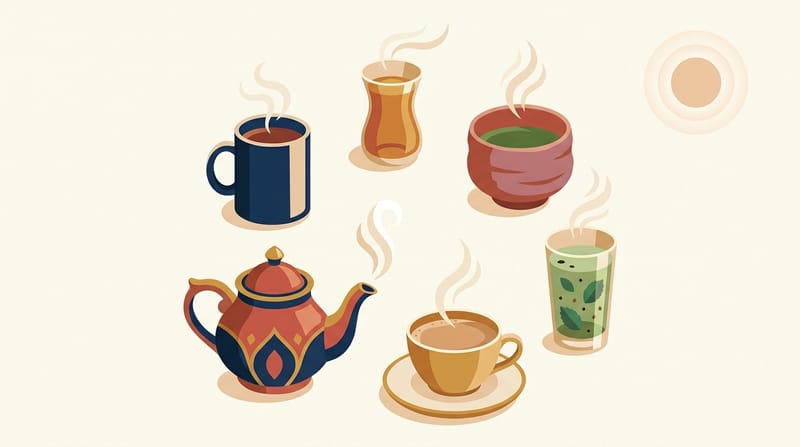
Although tea comes from the same plant, Camellia sinensis, differences in water temperature, leaf processing, serving vessels and social use have produced distinct traditions across cultures. In Japan, measured preparation and attentiveness stand out; in Morocco, mint tea is a visible part of hospitality; and in Türkiye, tea is a constant companion to everyday social contact.
The same leaf, different rituals
Some of these differences come from local tastes, while others reflect historical trade routes, production techniques and forms of hospitality. The temperatures and times below are not a single correct recipe; they are typical reference values used to compare six common preparation approaches.
Brewing profiles across six cultures
- JapanSencha (green tea)70°C · 1.5 min
Water at about 70°C helps limit harsh astringency in sencha and bring perceptions of umami and sweetness forward.
- ChinaOolong (gongfu cha)90°C · 0.5 min
In the gongfu approach, short infusions allow the same leaves to be steeped repeatedly and the aroma to be followed in stages.
- United KingdomBlack tea100°C · 4 min
Boiling water and a steep of about four minutes are a common preparation approach that brings out the full-bodied character of black tea.
- MoroccoAtay (mint green tea)100°C · 5 min
Green tea is prepared with fresh mint and often sugar; pouring from a height creates foam on the surface during service.
- IndiaMasala chai100°C · 8 min
Simmering black tea together with milk, water and spices at boiling temperature for several minutes creates the concentrated character of masala chai.
- TürkiyeÇay100°C · 15 min
Strong tea is brewed in the upper pot for about fifteen minutes, then diluted at service with hot water from the lower pot according to the preferred strength.
The temperatures and times shown are reference values representing typical ranges in common practice; they may vary with leaf, equipment and personal taste.
Service and context, country by country
Tea etiquette cannot be reduced to one national rule; it may vary by region, household, venue and ceremonial context within the same country. The notes below provide a basic framework for recognizing official or widely documented cultural practice, while the guidance of the local host or staff should always take priority.
Japan
Japanese tea culture includes everyday sencha and the more formally structured chanoyu as different practices within the same historical tea world.
Japan
Japanese tea culture includes everyday sencha and the more formally structured chanoyu as different practices within the same historical tea world.In Japan, tea spread after early influences from China through Buddhist circles and court culture; over time sencha became closely associated with everyday drinking, while matcha became strongly linked to the chanoyu tradition. In a formal tea ceremony, the sequence of movements, handling of utensils and mutual respect between host and guest matter. At visitor demonstrations, procedures are usually explained and flawless performance is not expected from guests.
Appropriate to do
- Support the bowl with both hands when receiving and returning it as a respectful gesture.
- At a formal ceremony, follow the host’s guidance on seating, turning the bowl and drinking.
- When sencha is prepared, recognize that a lower water temperature may be an intentional choice.
Best avoided
- Do not rush the ceremony as if it were a quick tasting session.
- Do not treat your own habits about bowl position or serving order as universal rules.
- Do not treat matcha ceremony and everyday sencha service as the same practice.
Source: Japan National Tourism Organization (JNTO), “Japanese Tea Ceremony”; Ministry of Agriculture, Forestry and Fisheries of Japan (MAFF), Japanese tea guides.
China
In China, tea forms part of a broad set of social practices extending from production techniques to hospitality.
China
In China, tea forms part of a broad set of social practices extending from production techniques to hospitality.UNESCO inscribed China’s traditional tea processing techniques and associated social practices on the Representative List of the Intangible Cultural Heritage of Humanity in 2022. The inscription considers cultivation, leaf picking, manual processing, drinking and sharing together. Gongfu cha is a preparation approach especially associated with southeastern China, using small vessels and successive short infusions to follow changes in the tea’s aroma.
Appropriate to do
- Follow the host’s rhythm during successive rounds served in small cups.
- Treat multiple short infusions from the same leaves as normal.
- Pay attention to differences among regional tea varieties and brewing styles.
Best avoided
- Do not present gongfu cha as the single mandatory way of serving tea throughout China.
- Do not automatically extend the first short infusion to a long Western-style steep.
- Do not reduce Chinese tea culture to a single tea type or one region.
Source: UNESCO Intangible Cultural Heritage, “Traditional tea processing techniques and associated social practices in China” (2022).
United Kingdom
In Britain, tea is both an everyday drink and, especially through afternoon tea, a more formal social serving tradition.
United Kingdom
In Britain, tea is both an everyday drink and, especially through afternoon tea, a more formal social serving tradition.Tea reached Britain in the 17th century and gained a strong place in social life over the following centuries through trade, empire and domestic consumption. Afternoon tea developed in the 19th century as a form of service associated with the period between lunch and a later evening meal. Today, formal afternoon tea may be a special occasion, while everyday tea drinking is much simpler and more flexible.
Appropriate to do
- At formal afternoon tea, follow the order of service and the host’s arrangement.
- Accept that milk or sugar preferences may be personal.
- Eat accompanying foods in small portions.
Best avoided
- Do not present the debate over whether milk goes in before or after tea as a mandatory rule of etiquette.
- Do not assume afternoon tea is the standard form of every daily tea break in Britain.
- Do not leave served black tea steeping so long that it becomes excessively astringent.
Source: British Council, “Reading the tea leaves” and “National Tea Day”; UK Government cultural and food history resources.
Morocco
In Morocco, mint green tea is closely connected with receiving guests and everyday conversation.
Morocco
In Morocco, mint green tea is closely connected with receiving guests and everyday conversation.The Moroccan National Tourist Office describes mint green tea as a ceremonial drink rooted in national traditions and as an element of welcoming guests. Tea is usually made with green tea, fresh mint and sugar, and pouring it into small glasses from a noticeable height creates foam. Because sugar level, mint variety and number of refills can differ from household to household, there is no single unchanging recipe.
Appropriate to do
- If accepting the offer, allow the glass to be filled and follow the host’s serving rhythm.
- Treat pouring from a height as part of the serving technique.
- Because sweet tea is common, politely ask for less sugar if that is your preference.
Best avoided
- Do not assume every Moroccan tea will have the same sweetness or mint ratio.
- Do not bluntly refuse a household or formal offering without explanation.
- Do not interpret high pouring as mere showmanship; it also serves to create foam.
Source: Moroccan National Tourist Office, “Moroccan Food & Drink”, “Authentic Hospitality” and “Time for Moroccan Tea”.
India
In India, masala chai is a broad name for many local recipes in which black tea is cooked with milk and spices.
India
In India, masala chai is a broad name for many local recipes in which black tea is cooked with milk and spices.Tea Board India describes masala chai as a flexible preparation in which Indian black tea can be combined with spices such as cardamom, ginger or cinnamon. Recipes vary by region, household and vendor; ratios of milk, water, sugar and spices are not fixed. For a visitor, the most accurate approach is therefore to understand the local recipe in its own context rather than measure it against a single 'national standard'.
Appropriate to do
- Where milk and sugar preferences can be specified in advance, state your preference clearly.
- Treat regional variation in the spice mixture as a natural part of the recipe.
- Be aware that a cup or glass in street service may be very hot.
Best avoided
- Do not reduce masala chai to one fixed spice formula.
- Do not assume the word 'chai' means only spiced milk tea; in many South Asian contexts it simply means tea.
- Do not treat a locally boiled recipe as if it used the same method as a short leaf infusion.
Source: Tea Board India, “Masala Tea / Masala Chai” and official Indian tea promotional materials.
Türkiye
In Türkiye, black tea is one of the main everyday drinks of hospitality and social interaction from homes to workplaces.
Türkiye
In Türkiye, black tea is one of the main everyday drinks of hospitality and social interaction from homes to workplaces.UNESCO inscribed the tea culture of Türkiye and Azerbaijan in 2022 on the Representative List as a 'symbol of identity, hospitality and social interaction'. In Türkiye, tea is commonly prepared strong in a two-tier pot system and served hot in a tulip-shaped glass. Because the ratio of concentrate to hot water can be adjusted individually, light and strong preferences can be served at the same table.
Appropriate to do
- If needed, state briefly and clearly whether you prefer your tea light or strong.
- Because the tulip-shaped glass can be hot, carry it with support from the saucer.
- If you do not want tea, decline politely; a renewed offer may be part of everyday hospitality.
Best avoided
- Do not treat adding milk to Turkish tea as the default serving method.
- Do not leave the upper pot over high direct heat long enough to boil the tea.
- Do not assume the same strength, glass size or use of sugar is expected everywhere.
Source: UNESCO Intangible Cultural Heritage, “Culture of Çay (tea), a symbol of identity, hospitality and social interaction” (2022).
Tea vocabulary: one drink, different words
Tea terms have travelled across a wide geography through trade and language contact. The explanations below use narrow, functional meanings consistent with Merriam-Webster’s etymology for 'chai', Japan MAFF’s definition of matcha, UNESCO’s record of Chinese tea culture and relevant national cultural sources; similar-sounding words are not assumed to have followed the same historical route in every language.
| Term | Language / origin context | Meaning |
|---|---|---|
| chai | Hindi / Urdu and the Persian chay family | In South Asia, generally 'tea'; in English, a word often used for spiced milk tea. |
| matcha | Japanese | Green tea powder made by finely grinding tencha leaves; strongly associated with the Japanese tea ceremony. |
| gongfu cha | Chinese | An approach to 'skillful/careful tea preparation' using small vessels and successive short infusions; not a single standardized recipe. |
| atay | Moroccan Arabic | A local word for tea in Morocco; in everyday use it is frequently encountered in connection with mint green tea service. |
| çaydanlık | Turkish | A name for a tea pot/kettle; in Türkiye it is widely associated with the two-tier system with tea concentrate above and hot water below. |
Where can tea culture be observed?
There is no need to seek a particular brand or business to understand the cultural context. The venue types below are well suited to observing preparation techniques, serving etiquette and production knowledge more clearly; before visiting, check through an official channel whether the program actually includes education or a demonstration.
- Traditional tea house: for observing everyday serving rhythm and the use of local cups, glasses or pots.
- Tea museum: for contextual information on production history, processing tools and regional varieties.
- Cultural center with a ceremony demonstration: especially for watching structured practices such as the Japanese tea ceremony with explanation.
- Production-region tour: for seeing stages such as garden work, harvesting, withering, steaming, oxidation or drying at the source.
- Historic market or bazaar tea corner: for observing tea’s role in everyday trade and social interaction.
Portable equipment and preparation
A visitor does not need specialized or expensive equipment to try local tea. A small teapot or heat-resistant vessel, a removable strainer, a measuring spoon and, if possible, a simple thermometer are enough for most loose-leaf teas; for formal practices such as gongfu or chanoyu, it is more appropriate to use the venue’s own tools. During transport, dry leaves should be kept in closed packaging that protects them from odor, moisture and crushing.
Common cultural mistakes
The most common mistake is carrying a serving custom from one country into every tea culture. Expecting milk to be added to Turkish tea by default, rushing a Japanese ceremony like a quick tasting, treating high pouring in Morocco as mere performance, leaving the first gongfu infusion for four or five minutes, and searching for one 'correct' spice list for masala chai are examples. Another mistake is confusing ceremony with everyday drinking: formal afternoon tea, chanoyu or a gongfu session has a particular context, while tea drunk at home can be much more flexible. The safest approach for a visitor is to observe first, follow the guidance of the person serving and avoid presenting a personal preference as a local norm.