Packing a backpack is not simply a matter of filling every empty space. A reliable setup combines three tasks: controlling where the weight sits, confirming the cabin-baggage allowance for the booked flight, and separating liquids and batteries that are subject to security rules. This guide brings those decisions into one workflow, from what belongs at the bottom of the pack to which figures must be checked on an airline’s current baggage page. Whenever a numerical rule can change, the validity date is stated. If a limit cannot be verified from an eligible official source as of August 2026, no number should be assumed; the airline’s current baggage page must be checked instead.
Who sets cabin baggage rules?
No single body sets every cabin-baggage rule. The maximum external size, number of pieces, weight allowance and whether a separate personal item is included are primarily airline policies. Two carriers departing from the same airport can therefore impose different cabin allowances even when they use similar aircraft. What may pass through the security checkpoint is a different layer of regulation, normally shaped by the civil-aviation or security rules of the country or region of departure. The airport applies those screening requirements, while the airline may separately check its own size and weight limits at check-in or at the boarding gate.
That distinction matters in practice because passing security does not prove that a bag complies with the airline’s cabin allowance. Security staff focus on liquids, sharp objects, batteries and other safety restrictions; airline staff can focus on dimensions, weight and the fare that was purchased. Some airlines explicitly measure the bag including wheels and fixed handles, while others use a total-dimensions formula. Codeshare flights add another layer because the airline selling the ticket may not be the airline operating the aircraft. The final check should therefore compare the baggage allowance shown on the booking with the rules of the carrier identified as “operated by” on the itinerary.
Size and weight: the three figures to check
Three pieces of information should be checked together before treating a backpack as cabin baggage: the permitted external dimensions, the permitted total or per-piece weight, and the existence of a separate personal-item allowance. For dimensions, do not measure only the fabric body. Follow the airline’s definition and include wheels, fixed handles, protrusions and filled outer pockets where required. British Airways and KLM, for example, explicitly state as of August 2026 that wheels and handles are included in their published dimensions. A soft backpack may compress in a sizer, but its closed dimensions in normal use are the safer reference. Ticket type matters as well, so the airline name alone is not enough.
| Airline | Cabin bag size | Weight limit | Personal item |
|---|---|---|---|
| Turkish Airlines | 23 x 40 x 55 cm — as of August 2026 | 8 kg — as of August 2026 | 40 x 30 x 15 cm, 4 kg — as of August 2026 |
| Singapore Airlines | 115 cm (sum of dimensions) — as of August 2026 | 7 kg — as of August 2026 | 40 x 30 x 10 cm; 1 additional personal item as of August 2026 |
| British Airways | 56 x 45 x 25 cm — as of August 2026 | weight must be checked on the airline’s current baggage page as of August 2026 | 40 x 30 x 15 cm; 1 additional personal item as of August 2026 |
| KLM | 55 x 35 x 25 cm — as of August 2026 | 12 kg; combined with small bag as of August 2026 | 40 x 30 x 15 cm — as of August 2026 |
| Emirates | 55 x 38 x 22 cm — as of August 2026 | 7 kg — as of August 2026 | no separate personal-item allowance stated as of August 2026 |
| Qatar Airways | 50 x 37 x 25 cm — as of August 2026 | 7 kg — as of August 2026 | no separate personal-item allowance stated as of August 2026 |
The table below summarises the standard Economy Class or most common economy cabin allowance shown on the airlines’ own official baggage pages as checked in August 2026. Turkish Airlines, Singapore Airlines, British Airways, KLM, Emirates and Qatar Airways were selected because they are relevant to Roadvia destinations and to common Bangkok, Singapore, London and Amsterdam connections. Fare family, route, codeshare arrangement, aircraft or local regulation can produce a different allowance. The table is therefore a comparison reference, not the binding rule for a specific ticket; the final authority is the airline’s current baggage page together with the allowance displayed in the booking.
What goes in each part of the backpack
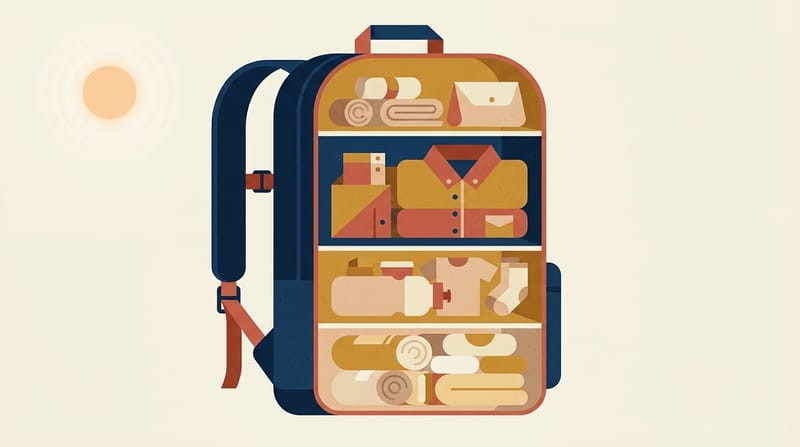
The colours in the backpack cross-section show the suggested weight class for each zone, not the importance of the item. The list is displayed from top to bottom for visual alignment, but the real packing sequence runs from the bottom upward. Light items that are unlikely to be needed during the day go in first. The heaviest and densest pieces then sit around mid-height close to the back panel, with medium-weight bulky items farther outward. Items needed during the journey remain near the top or in outer pockets. This is not a claim of a specific biomechanical effect; it is a practical summary of load-placement advice that recurs in backpack manufacturers’ user guidance.
Bag cross-section
Outer pockets and personal item
Weight: LightCarry light, small, frequently used items in outer pockets or the personal item.
- Passport
- Phone
- Power bank
Why here?
Outer pockets improve access; keeping heavy objects out of them helps avoid shifting the load away from the body.
Top compartment
Weight: MediumKeep medium-weight items needed in flight or on arrival near the top.
- Light jacket
- Headphones
- Snack
Why here?
The top is for access, so medium-weight items likely to be needed during the day are easier to retrieve here.
Middle — outer side
Weight: MediumPlace medium-weight bulky items outside the heavy core.
- Shoes
- Packing cube
- Toiletry bag
Why here?
This area stabilises the heavy core; manufacturer guides commonly place medium-weight items farther from the back.
Middle — close to the back
Weight: HeavyKeep the heaviest dense items at mid-height and close to the back panel.
- Water bottle
- Book
- Charger
Why here?
Manufacturer guidance commonly keeps heavy weight close to the body so the pack pulls less outward.
Bottom zone
Weight: LightPut light items that are unlikely to be needed during the day at the bottom.
- Sleeping bag
- Spare clothes
- Light towel
Why here?
Backpack manufacturers commonly recommend using light, soft items at the bottom to support the denser load above.
The list reads top to bottom for visual alignment; the actual packing sequence runs from the bottom upward.
Liquids, batteries and security screening
The liquids rule is a security rule and is separate from an airline’s cabin-bag dimensions. Under the European Union’s current passenger-security information, as of August 2026 the standard rule is that each liquid container may have a capacity of no more than 100 ml and the containers must fit in one transparent, resealable plastic bag with a maximum capacity of 1 litre per passenger. Having less liquid inside does not make an oversized container compliant. Exemptions can apply to medicines, baby food and qualifying duty-free purchases kept in the required security bag. For departures outside the EU, do not automatically copy the same figures; check the civil-aviation or airport-security rule for the place of departure.
For lithium batteries, the key distinction is between a battery installed in equipment and a spare battery or power bank. IATA’s passenger guidance dated 31 March 2026 states that, as of August 2026, spare lithium batteries and power banks must be carried in cabin baggage and protected against short circuit. The same guidance limits passengers to a maximum of two power banks, each not exceeding 100 Wh, while noting that airlines may impose stricter conditions. Batteries above 100 Wh or cases requiring operator approval should be checked against the airline’s current dangerous-goods page. Sharp objects, flammables, explosives and some tools are also typically prohibited or restricted and must be assessed against the departure point’s security list.
- As of August 2026, for EU departures each liquid container may have a capacity of no more than 100 ml.
- As of August 2026, the EU rule requires liquid containers to fit in one transparent, resealable bag with a maximum capacity of 1 litre.
- As of August 2026, IATA guidance requires spare lithium batteries and power banks to be carried in cabin baggage only.
- As of August 2026, IATA guidance limits passengers to a maximum of two power banks, each no more than 100 Wh.
- As of August 2026, IATA guidance says power banks must not be recharged from an in-aircraft power supply.
- As of August 2026, spare lithium-battery terminals must be individually protected against short circuit.
Concrete decisions that reduce weight
Excess cabin weight often comes from several dense items rather than one obviously large object. A second pair of shoes, a thick book, multiple chargers, a large power bank and a water bottle filled after security can consume the allowance surprisingly quickly when combined. The biggest saving usually comes not from compressing clothing more tightly but from removing one heavy category. Once essential electronics are identified, duplicate adapters and cables can be left out; printed reading can be reduced when a digital version is practical; and the need for a second pair of shoes can be reconsidered. Carry the water bottle empty through security and decide whether to fill it afterwards.
- Wear the heaviest shoes on the flight; pack a second pair only if it is genuinely needed.
- Remove duplicate chargers, adapters and cables that perform the same job.
- Use a digital edition instead of a printed book when practical.
- Take the water bottle through security empty; add the water weight afterwards.
- Decant toiletries into small containers containing only what the trip requires.
- After closing the bag, measure and weigh it again against the airline’s permitted limits.
Frequently asked questions
What happens if the cabin-bag size is exceeded?
Can a power bank go in checked baggage?
Does a backpack count as a personal item?
Sources
Sources and access date: Turkish Airlines “Cabin baggage”, Singapore Airlines “Cabin Baggage”, British Airways “Baggage essentials”, KLM “Hand baggage allowances”, Emirates “Cabin Baggage Rules” and Qatar Airways “Baggage allowance” were checked on 25 August 2026. For liquids, this article uses the European Commission Mobility and Transport passenger notice “Prepare liquids for security control”. For lithium batteries and power banks, it uses IATA’s “Guidance Document for Passengers Travelling with Lithium Batteries – 2026”, version dated 31 March 2026. Because airline and security rules can change, the same official pages should be checked again on the travel date. Official pages: https://www.turkishairlines.com/tr-tr/bilgi-edin/kabin-bagaji/ ; https://www.singaporeair.com/en_UK/sg/travel-info/baggage/cabin-baggage/ ; https://www.britishairways.com/content/information/baggage-essentials ; https://www.klm.com/information/baggage/hand-baggage-allowance ; https://www.emirates.com/us/english/before-you-fly/baggage/cabin-baggage-rules/ ; https://www.qatarairways.com/en-ae/baggage/allowance.html ; https://transport.ec.europa.eu/document/download/a48be027-b57f-4b6e-b6fb-2adb7c3a75ad_en ; https://www.iata.org/contentassets/6fea26dd84d24b26a7a1fd5788561d6e/passengers_travelling_with_lithium_batteries.pdf