When choosing where to stay in Tokyo, the hardest question is often not “which area is closest to the center?” because the city does not function around a single center. For a first visit, a more useful measure is the travel effort repeated every day: which direction you leave in the morning, where you return from at night, how many transfers you make, how far you walk inside major stations, and how tiring that pattern becomes with luggage. Shinjuku, Shibuya, Ueno, Asakusa and Ginza can all be strong bases, but for different itineraries. This is not a hotel list; it is a decision framework for dividing your itinerary into areas and seeing which base connects most closely to your daily routes.
Compare daily travel effort instead of chasing one Tokyo “center”
Having many sights in one area does not automatically make it the better place to stay. The real difference grows when the same movement is repeated for three or four days. If your days cluster around Shinjuku, Shibuya, Harajuku and nearby western Tokyo, Shinjuku or Shibuya can reduce cross-city travel. If your plan leans east and central, Asakusa, Ueno, Akihabara, the Tokyo Station area and Ginza form a more natural cluster; Ueno, Asakusa or Ginza may then create fewer trips in the wrong direction. As of 2026, Tokyo’s official transport network links these areas with many lines, but a good connection does not always mean a short or easy trip. Transfers, platform changes, crowds and walking inside stations are separate costs.
First divide your sightseeing days into east and west clusters
Grouping days is more useful than counting individual pins on a map. A western-heavy plan means Shinjuku, Shibuya, Harajuku, Omotesando and similar stops recur on the same or consecutive days. An eastern and central-heavy plan means repeated starts and finishes around Asakusa, Ueno, Akihabara, Tokyo Station and Ginza. If your schedule is evenly split, do not chase a point halfway across the map; give more weight to the days that start earliest and the nights that finish latest. A plan that begins early around Asakusa places a different burden on your day than one that ends late in Shibuya or Shinjuku. Choose a base around the routes you repeat most often, not the visual middle of the map.
A station name is not enough: check the right entrance and internal walk
“Near Shinjuku Station” or “near Shibuya Station” is not enough information by itself. At large stations, the operator and line you use, the entrance you need and the walk to the platform can change the real experience. As of 2026, Tokyo Metro’s official station pages show exits, transfers and facilities separately, so check the walking route to the entrance you will actually use rather than relying on straight-line map distance. In Ueno, JR, Tokyo Metro and Keisei connections serve different directions; around Ginza, Ginza, Higashi-ginza, Ginza-itchome and JR Yurakucho can create different walking trade-offs from the same lodging address. With luggage, early starts or late returns, a few extra blocks or a long underground corridor can matter more than expected.
Compare areas against your travel priorities
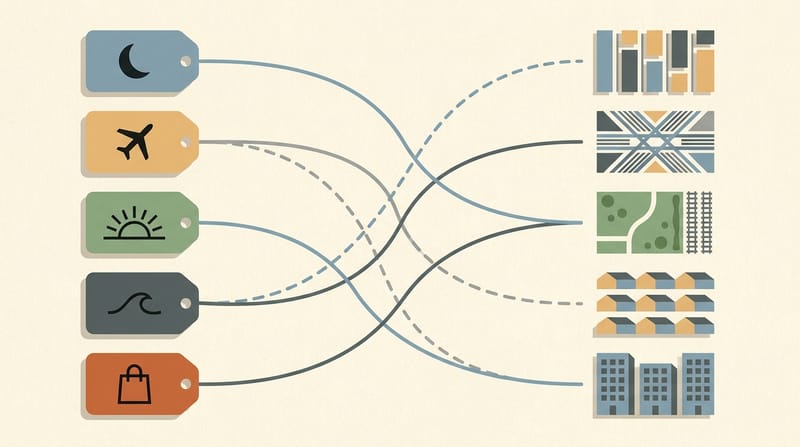
The matching below does not reduce “where is the best area in Tokyo?” to one winner. It links five priorities to the strengths and drawbacks of five possible bases. Late returns, airport or onward travel, east-Tokyo days, a calmer evening rhythm, and shopping or modern-Tokyo focus do not have to point to the same area. Narita and Haneda should not be treated as one access question either: as of 2026, Narita Airport’s official rail page shows Keisei links on the Ueno side and JR links toward Tokyo, Shibuya and Shinjuku, while Haneda’s official access page includes city connections via Keikyu and Tokyo Monorail. Airport choice, onward intercity route and the daily sightseeing plan should therefore be considered together.
Match a Tokyo base to your itinerary
The goal is not to find the most central area, but the bases with the strongest links to your itinerary. The same area can carry different weight for different priorities.
Trip priority
- Returning late
- Staying on the side where late-night plans cluster can reduce long cross-city trips and last-train pressure.
- Airport and onward route
- Narita, Haneda and intercity travel after Tokyo can require different lines and terminals.
- East Tokyo-heavy itinerary
- Repeated days around Asakusa, Ueno, Akihabara, Tokyo and Ginza can favor a base in the east or center.
- Calmer evening rhythm
- Travelers wanting less nighttime activity after busy days should weigh evening character alongside transport.
- Shopping and modern Tokyo
- A schedule concentrated around Shibuya, Ginza and Shinjuku can make a western or central base more practical.
Accommodation base
- Shinjuku
- Exceptionally strong transport and nightlife access, offset by station scale, crowds and potentially long internal walks.
- Shibuya
- Strong for western Tokyo, shopping and late plans, but crowds and the layered station can add walking.
- Ueno
- Useful for east Tokyo, the park and museum area, and northbound onward routes; its large interchange makes direction choice important.
- Asakusa
- Fits east Tokyo and early sightseeing well; cross-city trips to the west can involve transfers and longer travel.
- Ginza
- A central, orderly and shopping-focused base with useful access toward Tokyo and Yurakucho, though real walking distance varies by address.
- Returning late
- ShinjukuPrimary match
- ShibuyaPrimary match
- GinzaSecond option
- Airport and onward route
- UenoPrimary match
- ShinjukuSecond option
- GinzaSecond option
- East Tokyo-heavy itinerary
- AsakusaPrimary match
- UenoPrimary match
- GinzaSecond option
- Calmer evening rhythm
- UenoPrimary match
- AsakusaPrimary match
- GinzaSecond option
- Shopping and modern Tokyo
- ShibuyaPrimary match
- GinzaPrimary match
- ShinjukuSecond option
- Returning late: Shinjuku, Primary match
- Returning late: Shibuya, Primary match
- Returning late: Ginza, Second option
- Airport and onward route: Ueno, Primary match
- Airport and onward route: Shinjuku, Second option
- Airport and onward route: Ginza, Second option
- East Tokyo-heavy itinerary: Asakusa, Primary match
- East Tokyo-heavy itinerary: Ueno, Primary match
- East Tokyo-heavy itinerary: Ginza, Second option
- Calmer evening rhythm: Ueno, Primary match
- Calmer evening rhythm: Asakusa, Primary match
- Calmer evening rhythm: Ginza, Second option
- Shopping and modern Tokyo: Shibuya, Primary match
- Shopping and modern Tokyo: Ginza, Primary match
- Shopping and modern Tokyo: Shinjuku, Second option
These links are not absolute rules. After making a shortlist, also check the real walk from the lodging to the station, the correct entrance and the route to your platform.
To turn the diagram into a personal decision, first choose the two priorities that matter most to you. Then shortlist areas that receive a primary or secondary link from both priorities; areas with more shared links are more consistent with your itinerary, but this is not a verdict on the “best area.” The final step is the actual lodging address: check which station and line you will use, the walk to the correct entrance, the internal transfer and your arrival with luggage. If late returns matter, prioritize where the final journey starts; if early departures matter, prioritize the cluster containing your first destination. That makes the choice about repeated daily transport load rather than the district name alone.
The real differences between five areas: itinerary, rhythm and walking load
West Tokyo: Shinjuku and Shibuya
Shinjuku and Shibuya fit travelers who will spend much of their trip in west Tokyo and concentrate shopping and evening plans on that side of the city. Shinjuku’s strength is the number of JR, subway and private railway lines meeting at one major hub. That creates many routing options, but the station’s scale is itself a cost: finding the correct exit, long underground passages, peak-hour crowds and walks between platforms can be tiring, especially with luggage. Shibuya also connects naturally with west Tokyo, Harajuku and Omotesando, and it works well for shopping and late plans, yet its multi-level station and heavy pedestrian flow can add substantial walking. If late returns are frequent, either area may reduce long cross-city trips. If most mornings start in Asakusa, Ueno or farther east, the same advantage can reverse and create a repeated daily crossing. Choose by the actual walk from the accommodation to the line and entrance you will use, not by the district name alone.
East Tokyo: Ueno and Asakusa
Ueno and Asakusa can reduce repeated travel for itineraries centered on Asakusa, Ueno, Akihabara, the Tokyo Station area and Ginza, but they play different roles. Ueno is a major interchange: JR and Tokyo Metro links, together with the park and museum district, make it useful for east Tokyo days and for plans continuing north or to other cities. The trade-off is a large station footprint, entrances belonging to different operators and the extra effort of finding the right route with luggage. Asakusa gives a more direct start for early visits in the historic area and is served by the Tokyo Metro Ginza Line and Toei Asakusa Line. As of 2026, GO TOKYO shows that reaching Shinjuku requires a transfer, so west-heavy days can involve more cross-city travel. Evening activity is generally less continuous than in Shinjuku or Shibuya, but quiet should not be assumed. The practical choice still depends on the real walk to the relevant station and entrance, luggage handling, and where late returns will come from.
Central Tokyo: Ginza
Ginza suits travelers who want an orderly central base, place shopping high on the itinerary and value access toward Tokyo Station and Yurakucho more than those simply looking for a place halfway between east and west. As of 2026, GO TOKYO lists the Ginza, Marunouchi and Hibiya lines at Ginza Station, with Ginza-itchome, Higashi-ginza and JR Yurakucho also serving the area. This range of options is useful, but staying in Ginza does not mean every property is equally close to one station; depending on the address, walking several blocks or using a different station may be more sensible. Evenings have shopping and dining activity but a different rhythm from the nightlife focus of Shinjuku or Shibuya, which may suit travelers who want a more ordered end to a busy day. Early access toward Tokyo Station can matter for onward intercity plans. Still, a central address does not eliminate repeated trips deep into west Tokyo or out toward Asakusa. The final decision should follow the actual walking and transfer chain.
Five final checks before booking
- Map your sightseeing days: treat east and central days around Asakusa, Ueno, Akihabara, Tokyo and Ginza separately from west-side days around Shinjuku, Shibuya, Harajuku and Omotesando. Check which base removes more repeated starts and finishes.
- Evaluate airport access separately from your route after Tokyo. Narita and Haneda do not use the same access pattern, and the train or bus terminal for your next city may point to a different base from the area that looks easiest on arrival.
- Measure the walk from the actual accommodation address to the station entrance you will really use. At major stations, straight-line distance is not enough; the correct exit, underground corridors, road crossings and the walk to the platform matter with luggage and when repeated every morning.
- Build a late-return scenario. Identify where the latest evening is likely to finish and consider last-train pressure, transfers and the final walk from the station together. Do not treat being in an entertainment district as an advantage by itself.
- Calculate luggage and in-station transfer load separately. Stairs, finding elevators, long platform changes and moving between operators can make a short map distance tiring in practice; a simpler route can be more valuable on arrival and departure days.