Travel usually disrupts routine more than fitness itself: familiar walking times, sleep, meals, and exercise settings can all change at once. This guide uses general guidance from the World Health Organization (WHO), CDC, NHS, and civil aviation sources to explain practical ways to keep moving, break up prolonged sitting, make city walking count, and return to routine after a trip.
How much movement is enough?
WHO recommends that adults get 150–300 minutes of moderate-intensity aerobic physical activity a week, or an equivalent combination of moderate- and vigorous-intensity activity, and add muscle-strengthening activity involving the major muscle groups on 2 or more days a week. That target is not limited to gym workouts: walking for transport, taking stairs, and movement built into daily life can also contribute to physical activity. While traveling, it is often more useful to think about the moderate-intensity movement and strength work accumulated across the week than to search for one perfect workout. The example below shows how different forms of movement on a city trip could add up within one weekly total; it is not previously measured travel data.
Example travel week
WHO weekly target: 150 min
- Walking the city165 minAcross five days of sightseeing, an average of thirty-three minutes of moderate-paced walking per day adds up to 165 minutes.
- Terminals and transfers30 minModerate-paced walking accumulated through airports, stations, and transfer corridors totals 30 minutes in this example week.
- Short hotel-room circuit45 minQuiet bodyweight sessions spread through the week total 45 minutes in this example.
- Taking the stairs15 minChoosing stairs instead of lifts when practical adds 15 minutes of movement across this example week.
Total255 minabove target
These figures are a representative weekly example, not measured user data. To count your own week, record the time spent walking or doing other activities at moderate intensity and compare the weekly total with the WHO target.
Break up prolonged sitting
On planes, buses, and trains, the issue is not only the duration of the journey but also long, uninterrupted periods of immobility. CDC says the overall risk of a blood clot on trips longer than four hours is generally very small, but risk rises with longer immobility and with additional personal risk factors. CDC advises moving the legs often, exercising the calf muscles, and getting up to walk about every 1–2 hours on long trips; the UK Civil Aviation Authority also supports cabin mobility and simple lower-leg exercises. These points are not a diagnosis or treatment for DVT; they are general travel-health guidance for interrupting long periods of sitting.
- Move your ankles: while seated, alternately lift and lower the heels and toes or make controlled ankle circles; CDC recommends frequent leg movement during prolonged sitting.
- Tighten and release the calves: briefly contracting and relaxing the leg muscles is among the seated calf movements CDC recommends for long journeys.
- Walk the aisle when practical: CDC recommends getting up and moving about every 1–2 hours on long trips, while the UK Civil Aviation Authority encourages greater mobility in the aircraft cabin.
- Remember fluids: the UK Civil Aviation Authority says adequate non-alcoholic fluid intake is important on a long flight; water is a simple option for regular drinking.
- Check for excessive tightness: CDC recommends comfortable, loose-fitting clothing for long periods of sitting. If shoes or socks feel uncomfortably tight, loosening them may improve comfort; medical compression stockings are a separate matter and higher-risk travelers should discuss them with a doctor.
Does city walking count toward the target?
WHO does not define physical activity only as planned exercise; walking for transport and everyday movement are part of the picture. But when counting toward the weekly moderate-intensity target, it is not accurate to treat every step as equal: slow window-shopping and a purposeful walk that noticeably raises breathing are not the same intensity. A practical way to judge moderate intensity is the talk test: a person can talk, but singing becomes clearly difficult. Hills and stairs can also raise the effort; the time counted toward the target should be the portions that genuinely reach moderate or higher intensity.
| Pace | How can you tell? | Counts toward WHO target? |
|---|---|---|
| Light strolling | Talking and singing remain easy; breathing does not noticeably speed up. | Useful general movement, but not enough on its own for the moderate-intensity target. |
| Moderate pace | Talking is possible, but singing becomes difficult and breathing is faster. | Yes. Time spent at moderate intensity can be added to the weekly target. |
| Hills or stairs | Speech may shorten to briefer sentences; breathing and effort rise compared with level ground. | Yes, if the effort reaches moderate or higher intensity. |
| Brisk walking | Talking is possible but takes clear effort; long sentences may become difficult. | Yes, as long as it reaches moderate or vigorous intensity. |
Equipment-free movement in a hotel room
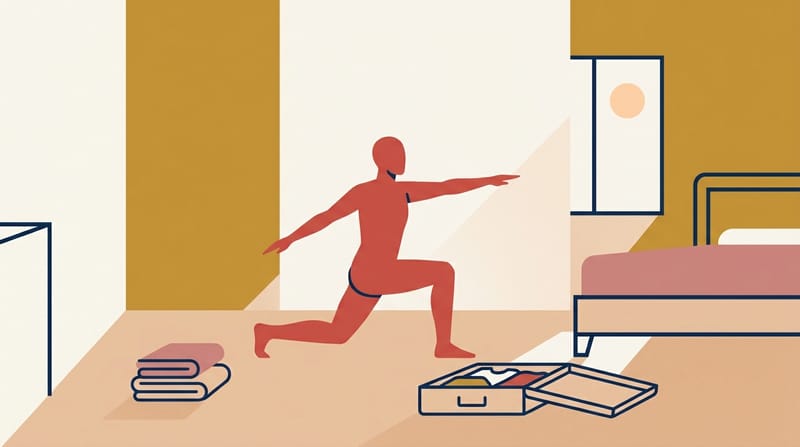
Hotel rooms can be small, a gym may not be available, and other guests may be staying below or next door. A travel-friendly short session can therefore use movements that do not require jumping, fit into a small area, and work major muscle groups in a controlled way. WHO recommends muscle-strengthening activity on 2 or more days a week, but the cards below are not a personalized program or a prescription for sets and repetitions. Stop exercising if pain, dizziness, shortness of breath, or unusual discomfort occurs; anyone with a medical condition or recent surgery should seek medical advice before starting.
Chair sit-to-stand
How to do it Stand in front of a stable chair, sit down under control, then stand again while keeping the knees and feet in a comfortable, balanced line.
What it works Works the glutes, thighs, and other large lower-body muscles used in everyday sitting and standing.
What it adds Provides equipment-free lower-body strength work in a small space.
Wall push-up
How to do it Place the hands on a wall about shoulder-width apart, keep the body straight, bend the elbows to move toward the wall, then press back under control.
What it works Works the chest, shoulders, and triceps with little noise.
What it adds Adds upper-body pushing work without requiring floor space.
Glute bridge
How to do it Lie on your back with knees bent and feet on the floor, then raise and lower the hips under control without arching the lower back excessively.
What it works Works the glutes and hamstrings and supports trunk control.
What it adds Offers quiet posterior-chain work without jumping.
Bird-dog
How to do it From all fours, extend the opposite arm and leg under control, return without rotating the trunk, then change sides.
What it works Trains trunk stability and coordination of muscles around the back and hips.
What it adds Helps work on balance and trunk control in a small area.
Wall-supported calf raise
How to do it Use the wall lightly for balance, raise and lower the heels under control, and do not jump.
What it works Works the calf muscles and control around the ankle.
What it adds Adds standing lower-leg work without creating impact noise.
Wall-supported hip hinge
How to do it Stand a short distance in front of a wall with your back to it, soften the knees, send the hips backward toward the wall, then return upright under control.
What it works Practises the hip-hinge pattern while engaging the hamstrings and glutes.
What it adds Provides quiet, equipment-free practice of a basic movement pattern.
Nutrition and sleep: keep the basics
Food and sleep routines can change during travel; the goal is not to copy the home routine perfectly but to preserve the basics where possible. WHO describes a healthy diet through the principles of adequacy, balance, moderation, and diversity, and energy balance also plays a role in body-weight management. CDC advises adjusting to the local sleep schedule, drinking water, and using exercise strategically during the day when dealing with jet lag, while limiting stimulating effects in the evening. Regular main meals, balanced options including fruit and vegetables when available, adequate water, and adapting sleep to local time therefore provide a more sustainable framework than an all-or-nothing approach, even on a short trip.
Weight gain while traveling is inevitable.
It is not inevitable. WHO notes that body weight is influenced by the balance between energy intake and energy expenditure, and that regular physical activity contributes to weight control; travel may change that balance but does not predetermine the outcome.
Source: World Health Organization (WHO)
You cannot maintain fitness without a gym.
WHO does not limit physical activity to gym exercise; walking, transport-related movement, and everyday physical activity all contribute to total movement. Strength work can also be done safely with bodyweight.
Source: World Health Organization (WHO)
You should drink less water on a plane because it causes bloating.
Restricting water is not a general recommendation. The UK Civil Aviation Authority says adequate non-alcoholic fluid intake is important on long flights; people who have a medical reason to restrict fluids should follow their own clinician’s plan.
Source: UK Civil Aviation Authority
Sleep and movement routines do not matter on a short trip.
CDC notes that time-zone changes can temporarily affect sleep, attention, and physical performance, and that adapting to local sleep timing, drinking water, and appropriately timed activity can be used in jet-lag management. Basic routines still matter on short trips.
Source: CDC Travelers’ Health and CDC Yellow Book 2026
Return to routine after the trip
After travel, the goal is not to 'make up' all missed days in one workout but to return gradually to the usual routine. WHO’s weekly activity targets are built around consistency; a few irregular days do not require an overloaded session on return. If sleep loss, jet lag, or post-travel fatigue is present, keeping the first sessions within personal tolerance and re-establishing ordinary walking, meal timing, and sleep can be a more cautious approach. Pressure to compensate for a missed week can encourage rushed choices that add unnecessary fatigue or injury risk; pain, marked weakness, or a medical condition should prompt individualized advice from a health professional.