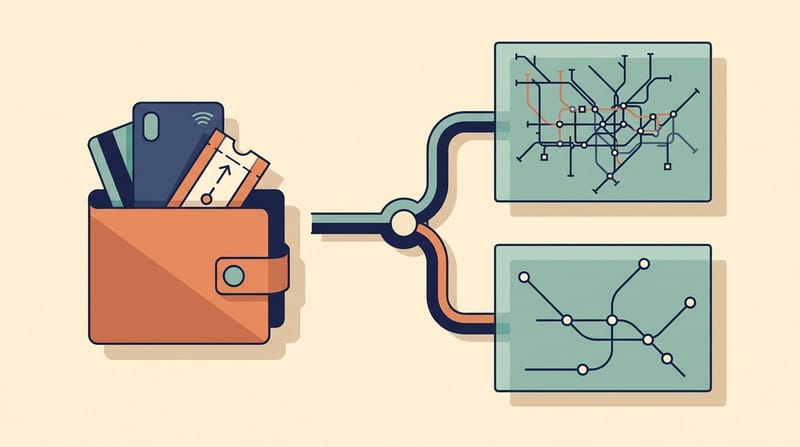
The first question to solve in Tokyo is not “which card is better?” but what each product actually does. Suica and PASMO are IC cards: on compatible rail, subway and bus networks, they make it easier to pay each fare from stored value. An IC card is not a transport pass. By itself, it does not provide unlimited rides or a package covering every operator. A pass or unlimited-ride ticket, by contrast, grants travel only within the operators, lines, time period and services stated in its conditions. For that reason, the Suica-versus-PASMO choice is usually less important than the route itself. The practical decision is whether the day uses JR, Tokyo Metro, Toei or private railways, and whether any train, seat or reservation needs a separate product. A compatible IC card can simplify pay-as-you-go travel across participating networks, while a day concentrated on one eligible subway network may give a network-specific pass a different role. Start with the real itinerary, not the brand name. A common first-time mistake is to treat the object used at the gate as if it defined ticket coverage. The same IC card may simply pay fares on several operators, while a pass may be invalid on the next operator.
Separate the IC card, the pass and the individual ticket first
To assess one day, write every trip on a separate line: origin and destination station, operator, line, and any special train or seat type. If a day combines an urban JR line, Tokyo Metro and a private railway, a single subway pass should not be assumed to cover the whole day. On mixed networks, a Suica or PASMO can deduct individual fares from stored value where accepted, making payment simpler, but that convenience is not the same as pass coverage. Conversely, if the itinerary is concentrated on one operator’s subway network, it is worth checking exactly which lines a day or timed ticket covers. The same logic applies to JR passes: “JR” in the product name does not automatically include Tokyo Metro, Toei or private railways. Passing a gate with an IC card also does not guarantee that the full cost of a limited express, Green Car, reserved seat or similar service has been paid. Any extra ticket or reservation must be checked against the official rules of the specific service. Likewise, a train continuing physically toward a destination does not prove the entire journey stays inside one fare or operator area.
Card or pass?
Choose the job before the product name: pay for trips one by one, or use travel rights within a defined network or period?
How does your day’s route work?
Pay per trip
Will you pay for each journey separately?
IC card such as Suica or PASMO
When does it fit?For a traveler making individual trips across different participating operators in Tokyo and wanting to reduce the need to buy a separate basic ticket each time.
What does it not cover?It is not unlimited travel and does not automatically cover every pass, premium train charge, reservation, seat service, or continuous trip across separate IC usage areas.
Individual ticket, reservation or required add-on
When does it fit?For a specific limited express, Shinkansen, reserved seat, Green Car, or an occasional journey that an IC card alone does not fully cover.
What does it not cover?It applies only to the journey and service stated on it; it is not a general transport card or an all-day network pass.
Travel within a defined scope
Are most trips concentrated within one operator or covered network?
Tokyo Metro/Toei coverage tickets
When does it fit?For a plan with many trips, on the same day or within the product’s valid period, on the Tokyo Metro and/or Toei services explicitly included by that ticket.
What does it not cover?Depending on the product, it may cover only Tokyo Metro, only Toei, or both; JR and private railways are not included unless explicitly stated.
JR pass or regional JR pass
When does it fit?When a significant part of the itinerary consists of JR journeys explicitly covered by the pass conditions and the actual trains have been checked route by route.
What does it not cover?Tokyo Metro, Toei and private railways are generally outside the scope; through travel onto another operator and certain premium services may require extra fares or separate rules.
As the last step, mark the day’s route by operator and match every ticket or pass to the trips explicitly covered by its conditions.
After the decision tree, the final check is straightforward. The same map color or station name does not merge different operators’ ticket systems. Even where JR, Tokyo Metro, Toei and a private railway are physically close, coverage must be read by operator and service. On a mixed-network day, the main benefit of an IC card is easier payment on compatible networks; it does not mean one pass covers every ride. On a day concentrated on one network, the relevant pass may align better with the itinerary, but that conclusion should come only after matching the actual stops and operators. IC interoperability is broad, yet continuous travel between separate IC usage areas is not possible on every route. Premium trains, Shinkansen, reserved seating and Green Car services can also separate the basic fare from additional service charges. Before buying, label each segment of the day by operator, line and service type, then choose only from the official product conditions. Recheck whenever the plan changes, because a metro-heavy day can become a very different payment pattern once JR and private lines are added.
Same Station, Different Operators: JR, Tokyo Metro, Toei and Private Railways
In Tokyo, platforms with the same station name, or located inside the same station complex, may belong to different operators. JR East, Tokyo Metro, Toei and private railways are not one ticketing network. When changing lines, check not only the walking distance but also which operator runs the next segment. An IC card may simplify payment on both lines, but that does not make a JR pass valid on the subway or a subway ticket valid on JR or a private railway. When assessing a pass, read the operator, line and service name together rather than relying on the station name alone.
When should JR urban lines be treated separately?
JR lines connect many important parts of Tokyo, but they are not part of Tokyo Metro or Toei. If using the JAPAN RAIL PASS or a regional JR pass, count only the JR services explicitly included in that product’s conditions. On some days JR may be a major part of the itinerary; on others, most trips may fall on subway or private railway networks. Saying “I will use many trains in Tokyo” is therefore not enough to justify a JR pass. Mark each day’s route by operator and check the exact coverage.
Why must Tokyo Metro, Toei and private railways be checked separately?
Tokyo Metro and Toei are separate subway operators. Some tickets cover only one operator, while others cover both; always read the product name and official validity conditions. Private railways have their own operating and fare systems. The fact that PASMO or Suica is accepted as payment on a private line does not mean that a Tokyo Metro, Toei or JR pass covers that line. Even when signs and platforms are close together at a transfer hub, pass validity is determined by the written conditions of the ticket, not by physical proximity.
Passing the Gate with an IC Card Does Not Mean Every Service Charge Is Paid
Being able to enter through the gate with Suica or PASMO does not necessarily mean that every fare component for the train has been covered. On ordinary urban journeys that accept IC cards, the basic fare can be deducted from the stored balance. Certain train types, seat classes or reserved services may still require another ticket, surcharge or reservation. Instead of asking only “Can I use an IC card?”, ask “Does this service require anything in addition to the basic fare?” Check the exact service name and seat type on the operator’s official page.
Limited Express, Shinkansen, Reservations and Green Car
JR East states that when using Suica on super limited express, limited express or express trains, or in a Green Car, an additional relevant ticket may be required. Shinkansen, reserved seats and similar services should not be reduced to one universal rule; the ticketing method can vary by product, train and reservation system. In some arrangements an IC card can handle the basic fare or gate entry, but that does not remove an additional service charge. Verify the train name, seat class, reservation status and any additional ticket requirement on the relevant JR or operator page before travel.
Airport Trains, Through Services and IC Area Boundaries
Not every airport train is run by the same operator, and the ability to pay with Suica or PASMO does not mean that a JR or subway pass covers that airport trip. With through services, the same physical train may continue onto another operator’s tracks. Staying on the train does not guarantee that the fare rules or pass coverage remain unchanged. JR East also notes that Suica cannot always be used for continuous travel between separate IC usage areas; some journeys crossing those boundaries require a separate ticket in advance. Airport and longer-distance days should therefore be checked separately from routine urban travel.
Final 5 Checks Before Buying
- Write down every station pair for the day and the operator for each segment.
- Remember that an IC card is not a transport pass; it is a stored-value payment method on eligible journeys.
- If considering a pass, match every covered operator and service against your actual daily route.
- Check whether limited express, Shinkansen, Green Car, reserved seating or another additional ticket is required.
- Treat airport and intercity travel days separately from ordinary city travel days.